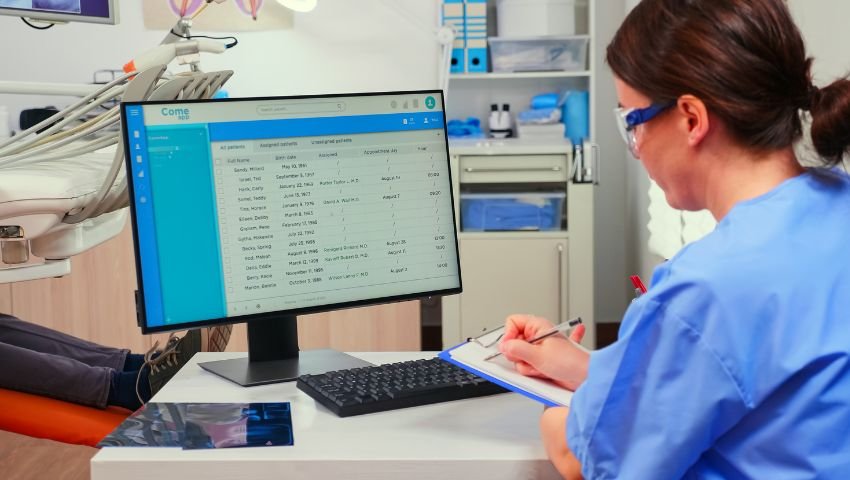
AI in IVF is not a replacement for embryologists or clinicians. It is strong at consistent, repetitive assessment across large volumes of data, while people stay in charge of judgement, context and accountability. The working split is machine strengths on the routine and human strengths where a decision carries consequence.
If you run an embryology lab or a fertility clinic you have probably heard that AI is about to change everything. It is worth cutting through the noise. AI in IVF is not a replacement for your embryologists or your clinicians. It is a tool that reads patterns in data faster than any person can and hands that reading back to a trained human who decides what to do with it. This post looks at what that partnership really means, what machines are genuinely good at and what your people must keep firmly in their own hands.
Strip away the marketing and AI in fertility care does one thing well. It looks at large amounts of structured data, finds patterns that recur and produces a score or a ranking. Feed it thousands of images or lab values and it learns which features tend to go together. It does not understand a patient. It does not know why a cycle matters to the couple in front of you. It matches inputs to patterns it has seen before and offers a suggestion.
That is a useful thing to have on your side. It is not a clinician and it does not pretend to be one. The value shows up when a person who does understand the patient uses that suggestion as one more input among many.
Software does not get tired at the end of a long retrieval day. It does not score the last embryo of the afternoon differently from the first of the morning. It applies the same criteria every single time, across every case, without the small drift that creeps into human judgment when a lab is busy or short staffed.
The tasks machines handle well tend to share three traits:
High volume and repetition where consistency matters more than intuition
Pattern spotting across more images or data points than a person can hold in mind
Round-the-clock monitoring that never blinks or takes a break
A score is not a decision. Only a clinician knows the full history, the patient's wishes, the earlier cycles that did not work and the hundred small signals that never make it into a dataset. AI cannot weigh a couple's values or explain a difficult choice with warmth. It cannot take responsibility for an outcome. Those things belong to your people and they should never be handed to a model.
The honest framing is simple. The machine narrows the field and the human makes the call. When you keep that order, AI adds real value. When you flip it, you have outsourced judgment to a tool that was never built to carry it.
The lab is where this partnership shows up most clearly. Time-lapse imaging systems capture embryo development around the clock and AI models can rank embryos by the features they have learned to associate with development. That gives the embryologist a consistent second opinion to compare against their own grading. It does not overrule the embryologist. It gives them a reference point that was produced the same way for every embryo in the dish.
For this to work the images and annotations have to be clean and connected. A well organised lab management layer keeps witnessing, grading and device output in one place, so the model reads from the same record the embryologist trusts rather than from a scattered pile of files.
| Task | The Machine | The Human |
|---|---|---|
| Ranking embryos by pattern | Fast and consistent | Reviews and confirms |
| Reading patient context | Blind to it | Owns it fully |
| Flagging an anomaly early | Watches nonstop | Interprets and acts |
| Explaining a hard choice | Cannot do it | Does it with care |
| Taking responsibility | Never | Always |
Picture a single cycle. During stimulation the software watches lab values and flags a response that is drifting outside the expected range, so the clinician looks sooner rather than later. At the bench the model ranks the embryos and the embryologist compares that ranking against their own reading before selecting. Through it all the coordinator sees the same live picture and keeps the couple informed.
Nobody was replaced in that story. Each person got a sharper set of inputs at the moment they needed them. That is the whole promise of human and machine working together, done without hype.
A model is only as honest as the data behind it. If your records are half on paper and half in three systems that do not talk, any AI you bolt on will read from an incomplete picture and its suggestions will be shakier for it. Clean connected records are the real groundwork. That is why a solid fertility clinic EMR matters more than any single clever feature. It is also why real-time analytics only help when they draw from one shared truth.
Vitrify is built so the lab, the record and the analytics all run on one connected platform, which is exactly the groundwork any useful AI needs. The point is not to remove your embryologists or clinicians from the loop. It is to give them cleaner data, a consistent second read and live signals across the cycle so the human decision is better informed. Your people stay in charge and the software does the tireless watching underneath. Book a demo and see how the pieces fit together.
No. AI ranks embryos and spots patterns quickly but it cannot understand a patient or take responsibility for a decision. The embryologist reviews what the model suggests and makes the final call. It is a second opinion, not a replacement.
It is good at high-volume, repetitive tasks where consistency matters, such as scoring embryos the same way every time or watching lab values around the clock. It finds patterns across more data than a person can hold in mind and hands that back as a suggestion for a human to weigh.
You should treat it as one input, not the decision. The score reflects patterns the model has seen. It has no view of the patient's history or wishes. The embryologist compares it against their own grading before selecting, which keeps a trained human accountable for the outcome.
Yes. A model reads only what your records hold, so if your data is split across paper and disconnected systems the suggestions will be weaker. Clean connected records and organised lab data are the real groundwork before any AI feature adds value.
Vitrify keeps the lab, the record and the analytics on one connected platform, which is the groundwork any useful AI depends on. It gives clinicians and embryologists cleaner data and live signals across the cycle while leaving every clinical decision with the human. Book a demo to see how it works.
AI-powered IVF is not a story about machines taking over. It is a story about giving skilled people a sharper tool. The machine reads patterns without tiring and offers a consistent suggestion. The human reads the patient, weighs the context and owns the decision. Keep that order and the partnership makes your clinic better without pretending to be something it is not. Vitrify is built to give your team that groundwork on one connected platform. Book a demo and see it for yourself.